The Logistics Townhouse: fixing the 3,000 vs 50,000 SKU gap in physical retail

A typical fashion store carries 3,000 SKUs. The online competitor carries 50,000+. That is not a fair fight.
But the problem is not retail — it is infrastructure.
Physical stores sacrifice selection for experience. Online sacrifices experience for selection. Customers lose either way.
The false choice: selection or experience
Every retail CEO knows the numbers. A well-merchandised flagship store gives a shopper atmosphere, service, a moment of delight — and 3,000 SKUs on the floor. Pure e-commerce gives them 50,000 SKUs and a cardboard box on the doorstep two days later. The customer has been forced to pick one at a time. Neither side can close the gap without giving something up:
- Stores cannot physically shelve more SKUs without destroying the experience.
- E-commerce cannot deliver instantly without building expensive, limited-SKU dark stores at every urban node.
The constraint is spatial — how a retail building is designed, stocked, and operated. Change the building, and the trade-off dissolves.
Enter the Logistics Townhouse
The Logistics Townhouse is not a dark store. It is not a flagship. It is both, in one building.
Street-level and first floor: a full retail experience — curated merchandising, fitting rooms, service staff, the moments that make people come back. Behind and above: a high-density, partially automated micro-fulfilment floor holding the long-tail SKUs the store cannot display.
The two halves run on one inventory pool, one staff roster, and one store management system. A customer asks for a size, colour, or variant that is not on the floor — and it arrives from upstairs before they have finished trying on the first option.
What the concept delivers
- Up to 75,000 SKUs under one roof — 25× the breadth of a standard flagship.
- Under 5 minutes from "do you have this in a 42?" to the customer's hand.
- +30–50% conversion uplift versus comparable standalone stores, driven by availability — customers stop leaving empty-handed.
- Dual P&L: the same square metres earn both retail gross margin and e-commerce last-mile margin, because online orders from the surrounding catchment ship from the same fulfilment floor.
What would change for your customers — and your stores — if every product was always available?
Presented at Deutscher Materialfluss-Kongress 2026
I shared the Logistics Townhouse concept on Thursday, 16 April 2026 at the Cube Stage of the Deutscher Materialfluss-Kongress (MFK 2026) — one of Europe's most influential intralogistics gatherings, organised by VDI Fachgesellschaft GPL and Technische Universität München at TEST CAMP INTRALOGISTICS.
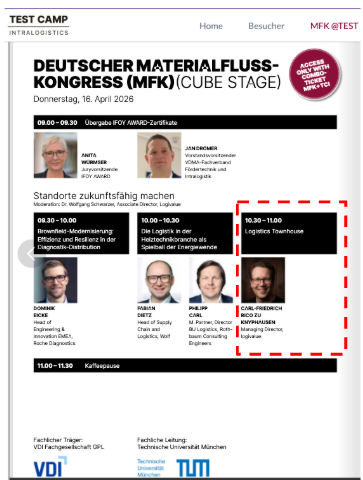
The talk sat alongside sessions from Roche Diagnostics (brownfield modernisation), Wolf (heating industry logistics under the energy transition), and the IFOY AWARD ceremony — a room full of the people who actually build, operate, and invest in industrial and retail logistics infrastructure.
Why this matters for retail strategy
The Logistics Townhouse is not a single-vendor product. It is a design pattern for rethinking how retail real estate is underwritten, located, and built — and where store operations end and fulfilment begins. The building type is new; the components (micro-fulfilment, automated picking, unified inventory) already exist. What has been missing is the spatial and operational integration.
For retailers wrestling with declining flagship footfall, shrinking e-commerce margins, and rising last-mile costs — and for investors holding large-format retail assets that no longer earn their yield — this is the most interesting empty square on the board.
Talk to us about the Townhouse
If you run a retail footprint, own the building, or are underwriting one, we can model what a Logistics Townhouse looks like for your specific catchment, SKU base, and conversion economics.